¶A decade ago.
First, I myself wanted to consolidate or close identities. Migrating accounts, e-mails, phone numbers. Some were closed too early, resulting in loss of authentication access.
It wasn’t intense at all, tops 5% of today. Mostly account recovery, in an era where I was slowly moving to password managers. Now doing the move, passwords aren’t enough for a login, or sometimes not even needed. Everything relies on e-mail.
I was collapsing under the loss from e-mail closures. Specifically one unannounced by Google for being too young. Instapermabanned from the e-mail account.
You ask, multiple? Because I can, dual sim invites you to. I think I haven’t had a phone without it. Of course, later it’s obnoxiously restrictive when balancing personal, work, junk, and travel SIMs.
The prepaid gave access to data. Every menu of the one and only feature phone was explored, including the ironically slow Internet. It was faster to walk or ride to the closest computer than to load and navigate 4 URLs.
It evolved to a burner. One number with which I was in contact books, one for trolling. Later, one for online signup and orders. Looking back, the decision for stability was then: migrations in 2nd party phonebooks are lossy, it’s best to keep one number for life.
¶aside: SIM-cards with benefits
Junk number uses today:
- Number used for purchases. Calling up people who don’t know me.
- Sales, classifieds. Publicly visible post-it ‘call x’.
- Account signups for “security” (making it more expensive for bots at the cost of major privacy).
- Anything not going straight to people’s phones.
- Backup reception and data, as the carrier differs from the personal SIM.
Originally, I got more spam calls and expected frequent rotation. Maybe with GDPR it’s less common. Each time I change, it’s n+1 years cycle from the previous one.
¶Fear in the unknown
My experiences with both moderate and tiny data loss all showed a need for indexes. If you know exactly what you lost, it’s much easier to rebuild and recover. Backups can be hard when the medium is not friendly, or too big.
ncdu -0o- "$filesystem" | zstd > "$(date -uI).ncdu.zst"
Gives a small snapshot of the filesystem, which is practical to regularly distribute. There are some added benefits, like near-instant ncdu and file search. It offers comfort when facing data loss. It’s easy to determine: (if,) how much, and how important data was actually lost.
¶Paying the void
My self-hosting began with 1$ domains, where renewal is much more expensive. Moving between them, discarding where experimenting. The setups started becoming useful, domain stability was welcome. There was an itch for vanity e-mail. It was good, except later it lacked ease of management features, and renewal more than doubled to 80€/yr.
For a stable domain, .net, .com, .org are my suggestions: mid- and long-term cheapest, on any registrar, best control, features like DNSSEC. Maybe it’s good that one’s first ties to internet dry away.
¶Commitment
About then, I found out about 3-letter domains and by chance scanned for 2-letters as well. There were hundreds available, before auctions for expired domains by the TLD. I decided on a domain and promised myself to do my best to keep it. E-mail migration is draining, time-expensive, and, in many cases impossible.
It has worked out very well. At a minimum I can reasonably promise others ’this link will stay for at least 5 years’. It can be printed, it can be linked to. In practice, only static files and redirects are fit for this.
¶aside: The Sellout
Last year I was asked to sell c7.ee due to its short name. I’m still known for my wealth of short domains. I said no, the cost of ditching stability and moving is worth, to me, multiple years of income. Some time later, I seeked an another 2-letter as a guarantor instead, when asked to sell.
¶aside: The Copy Machine
Keeping the domain and subdomains quickly typable and short has been worth it. Typing them tens, maybe hundreds of thousands of times over the years, or fitting 8-letter URLs to prints. One two-letter has been in use for limited-time “xy.zz for more” advertisements.
Unfortunately 2 ASCII-letter domains weren’t commonly available even before the auctions, it costs some time on mobile.
¶Freedom
jtag.cat, the username and domain didn’t instantly shine the illusion. It allowed word play like this blog, tail.jtag.cat. The actual reason was independence. In freedom to screw up, and to not lose everything (attention) at once. Digitizing, efficiency through makes each and every takedown and security failure an extreme all or nothing. Everyone is criminal until funded. Everything must carry a well-understood meaning.
I leave the door open for multiple (double) meanings, or just full nonsense, because it’s pretty. In my eyes, to be whole is to be messy, and be allowed to enjoy it.
Maybe frowned upon in the society of perfection. It is challenging to just be, without a blinding light mocking at all times to Fulfill The Mission. Funny, do you even value or know, what the proclaimed is? Nationalism – the only label attributable without any effort from the person itself. Somebody just comes and says “You are now X-ian, are supposed to behave, do X, and must have the following values!”. Anonymity loves company, but companies lead a mission to pedantically ID everything.
Domain registrars and e-mail providers are snakes eating themselves. Sign in to c7.ee with admin@c7.ee? Get notified of suspension of the domain via the domain? @eesti.ee government mailbox aliases solved the problem of a root, until they suddenly didn’t. Screwing up is fine, provided you know you have done so , and have broken pieces to pick up.
¶Betrayal
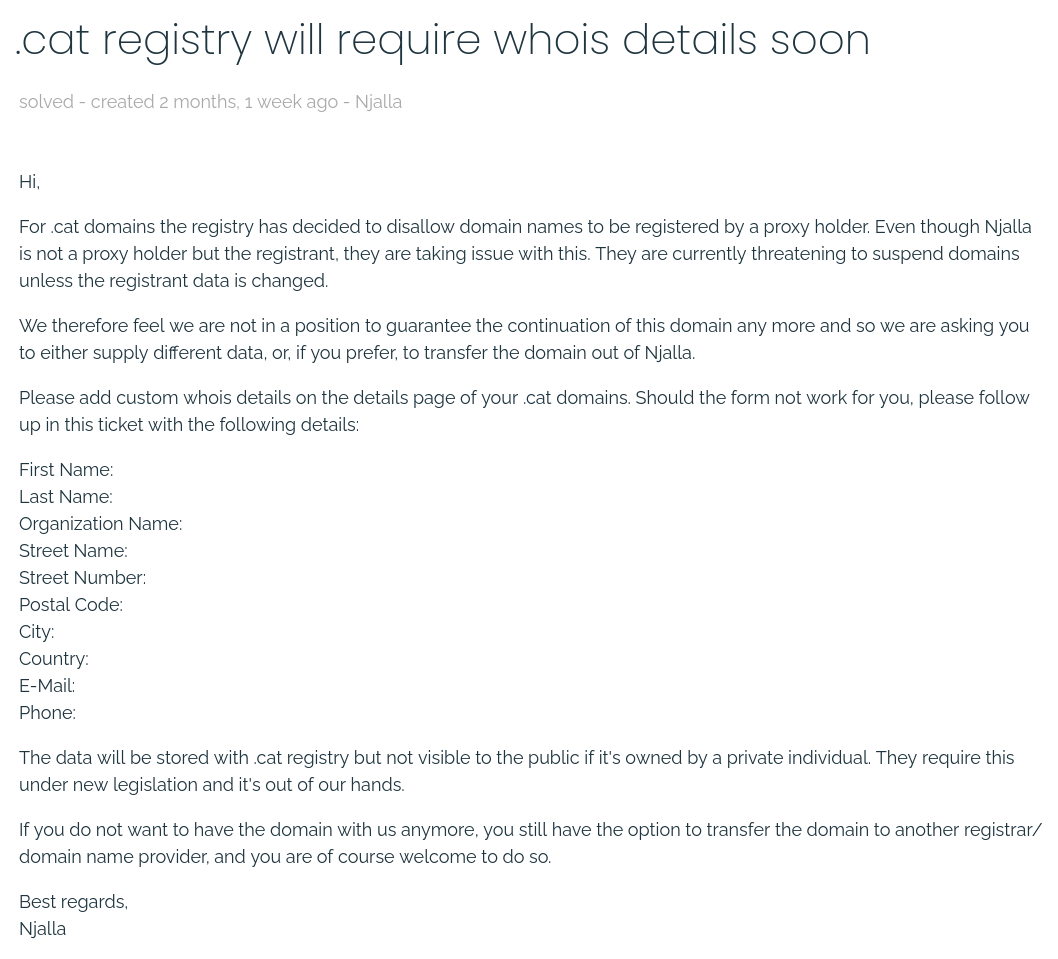
I don’t have much transparency into Njalla. Do they kindly fold TLDs when asked, or is .cat too small?
Researching a bit wider, the registry rules actually also require:
- Short description of purpose on renewal (haven’t had to do it ever). “Web hosting” would probably suffice.
- Content on the domain must provide Catalan translations. Yes, machine-garbo would tick the box when demanded, but it’s time and hassle. Maybe in 2040 they will ask port 22 to speak Catalan as well.
- Moneys.
.cat is expensive, and was barely justified before. Domains add up.
The .cat registry decided they must gobble up personal data in case of who knows. It’s second nature to provide a random First name, Last name, Address to web services. They don’t need it, they have no use for it. It wouldn’t be a problem to do the same with the registrar. It’s not like they need the info to suspend domains?
With the ongoing cost and potential extra time hassle in the future, I decided to just not. E-mail migration “only” took a day. Of never being forced to migrate domains. I don’t know, did I break the promise to myself?
Welcome to tail.c7.ee, with a bit less (world) play. Fuck everyone who contributed shatters to my glass of warmth in stable pseudonyms.